
Sheep shearing has belonged to human life for as long as humans have kept wool sheep. Those who owned the sheep also knew how to shear them, and did. It was a household skill long before it was a trade.
The number of books that mention shearing almost casually, as a matter of fact, seems endless. They keep arriving, mentioned to me as if I must already know, though soon enough I do, for I cannot help but acquire them all — building some home catalogue of sheep shearing I’m not even aware I’m assembling. If sheep, shearing, and wool are to be our future, then all the books, and stories, and manuals I shall have.
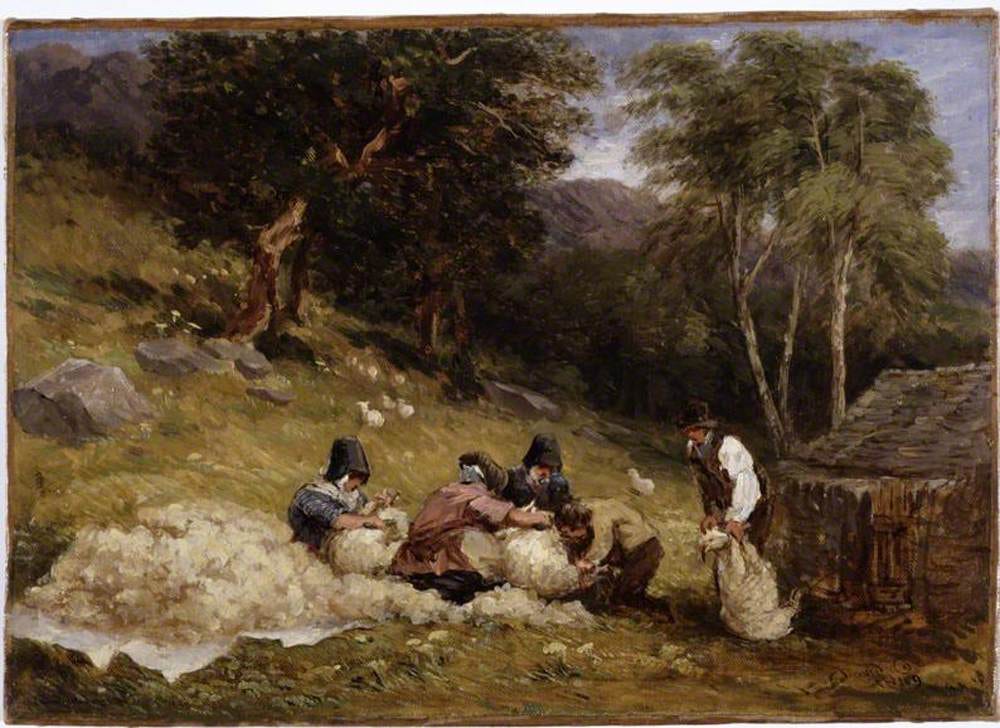
Today’s shearing is different from the days long past, though glimpses of that older grace still catch the eye at places like Coggeshall Farm in Bristol, Rhode Island, Old Sturbridge Village in Massachusetts, and in the countless paintings that preserved the craft when it still stood near the center of human life. It is no longer a household skill. It is something the household must take back. It is also a tradecraft on the decline. As far as I know, there is one active shearer left listed with the Rhode Island Sheep Cooperative. Her name is Sam, and we are lucky to have her as I learned that day.
The tools have changed surprisingly little across sheep shearing's millennia-long history. The great transition was from hand shears to powered clippers. Even today, watching a shearer work, the craft feels ancient, almost untouched by the industrialization that transformed so much else of human life. The efficiency-minded have already theorized ways to replace man with machine, as they have with milking cows. I understand the desire in some cases. But not here.
Shearing comes once a year. Man and sheep come together, and man removes by hand the burden of a fleece he bred into being in the first place, freeing the sheep to frolic the meadow weightless again.
There is a bottleneck if things stay this way: a dwindling tradecraft, and a loss of household knowledge on the shepherd’s part. When the season comes, you are beholden to the shearer and the weather. For Sam this is a second job, so her time is limited. The sheep need to be dry for a clean cut, for wet fleeces clog the clippers, a real drawback of the electric version. Hand shears, I suspect, are more impervious to weather and certainly more impervious to the demands of electricity. I had to run a couple strands of extension cord across the yard just to reach her. Dry sheep also mean quick storage, with no laying the wool out to dry indoors before bagging. Wet wool ruins fast.
People ask why I don’t shear the two of them myself. I’ll have to learn eventually, if I want to fully belong to this world, to reclaim the skill back to the household, as I want to do with so many other things. And I do want to show that man, sheep, and household can still come together today as I written poignantly about before. But alone, I’d have no one to guide me. No mentor. No pattern. No experienced hand to lead me through the work. So my rebuttal is: “Why go into the wilderness alone, risking injury and fruitless toil, when I could hire a skilled tradeswoman to lead me through it?” So that is what I did. What might have been an ugly, demoralizing afternoon alone became a beautiful one, for two families and for the sheep.
Shearing day came after two cancellations and a month of delay, finally landing on a dry day at the end of a dry stretch. The evening before, I had enticed Laura and Sally into the half-covered corral to limit their eating and drinking, to keep the next day cleaner for the shearer, the wool, and all of us. Sam said it wasn’t strictly necessary. Looking back, it was worth it. Sheep relieving themselves mid-shear would have been more than unsightly, and they had their reward coming anyway: fleece freedom and a long afternoon of grazing without overheating.
The morning of, I climbed into the corral, much to their chagrin, and wrangled them for the first time, fastening the harnesses, tying them to the bars, heads up and ready when it came time to lead them over.
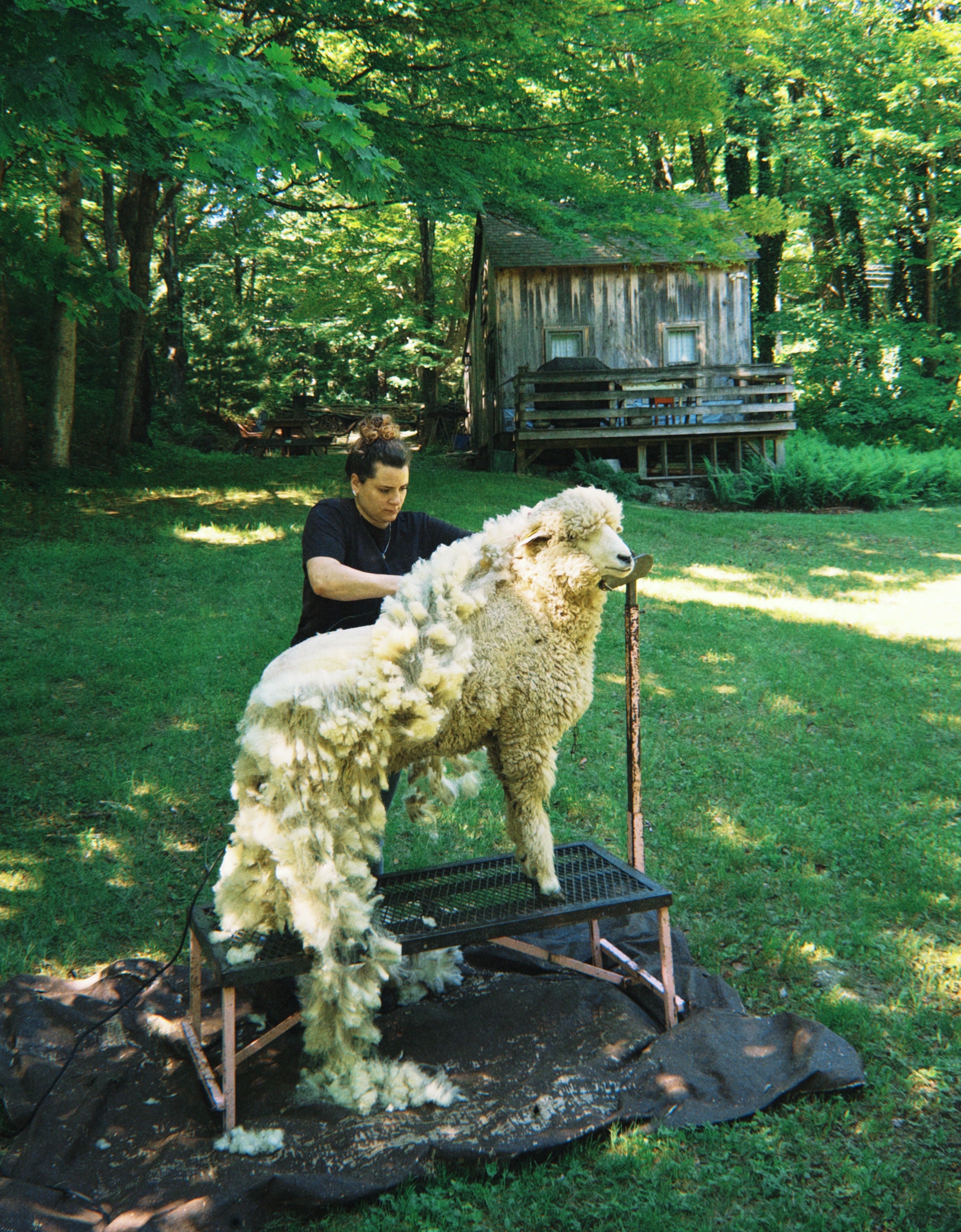
The station was simple: a stand with a tall vertical bar and a headrest, a chain that wrapped around the back of the neck, and a tarp underneath to catch the wool. The stand gave Sam leverage. The headrest held the sheep in place, mostly, save for a few moments when one stepped off and we all rushed to set it back. Behind us stood our Revolutionary War and George Washington reenactor’s cabin, set against the green lushness of a late spring New England day. It was picturesque for the momentous act.
Then, as we settled in, so did Sam, and the wool began to fall with each rhythmic stroke.
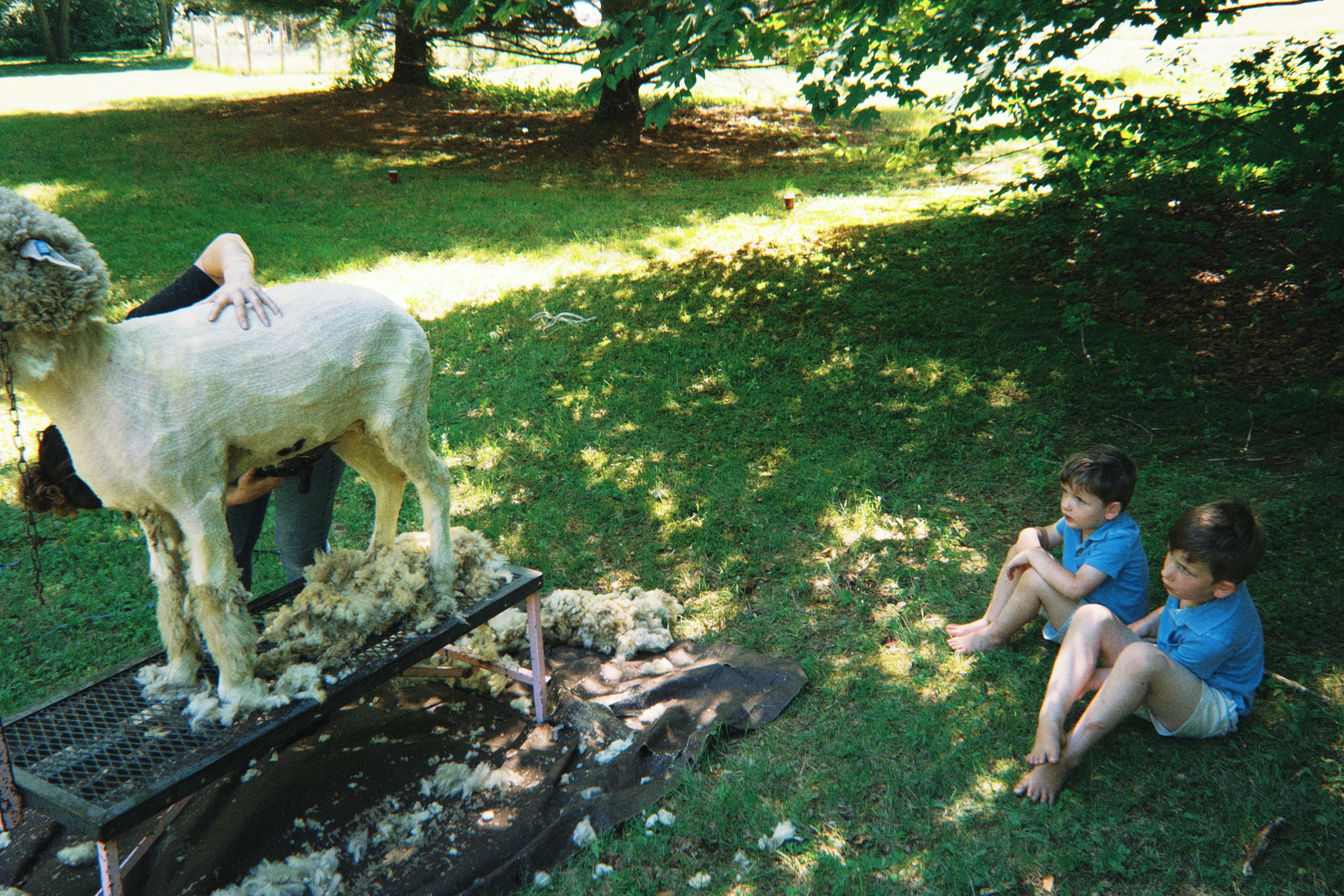
Watching her work through the fleece and over the contours of the body, handling the sheep’s erratic movements without breaking rhythm, I felt confirmed in deferring to the expert and watching as the novice. She always starts on the left, she told us, following a pattern honed since her teenage years at 4-H, when she stumbled onto the craft and never left it. It was a hobby that paid a little then and still does now, for her and her husband, who travel Rhode Island and parts of Massachusetts shearing sheep in their off hours.
Now here they were at our homestead, entrancing our children and us.
We were watching something true, good, and beautiful. It was hard not to grin the whole time. We were here, actually here, further along the road of building a rooted life in Rhode Island, with good and rooted friends.
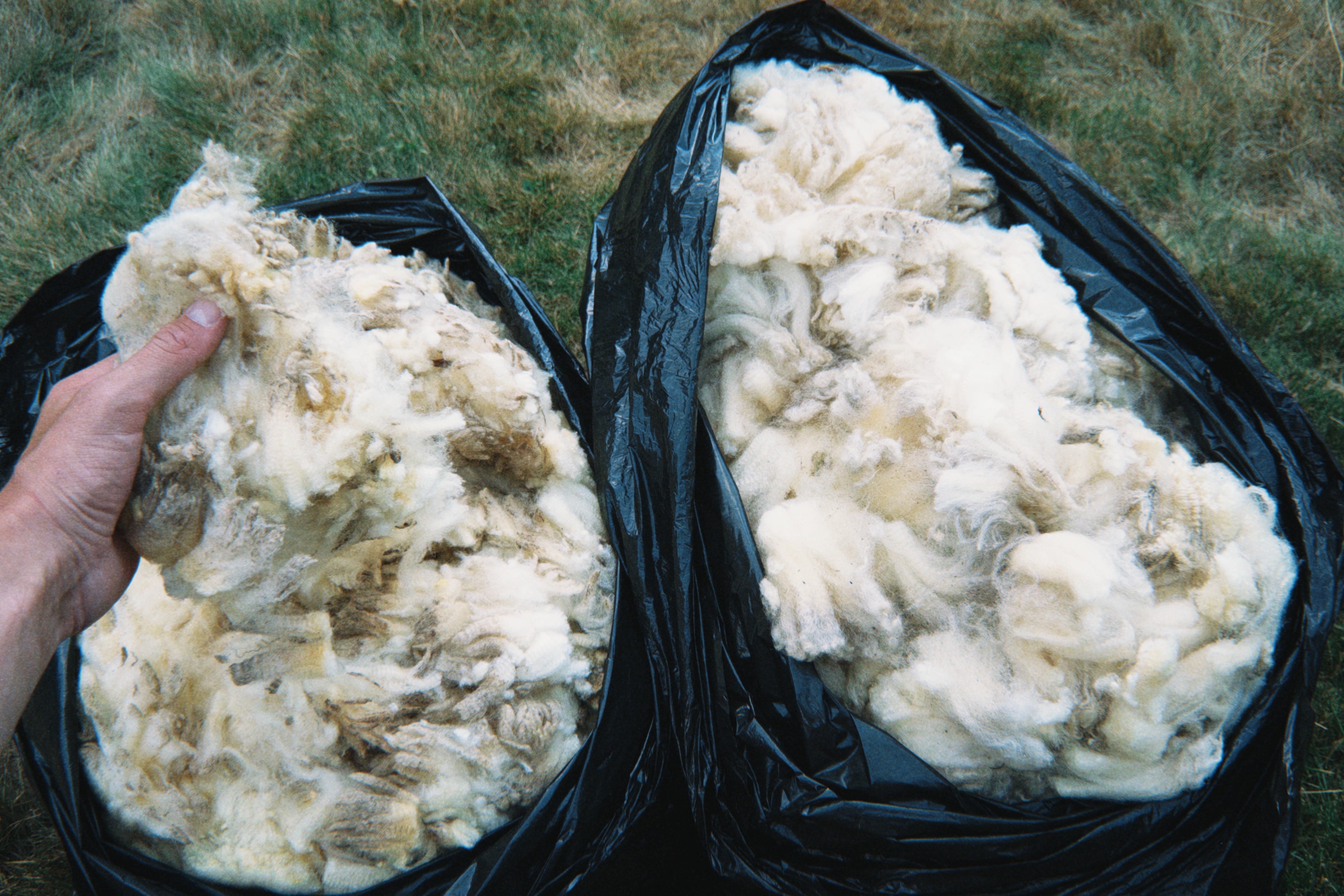
Sam sheared to keep the fleece as intact as she could, for a greater yield of finished yarn, and bagged the soiled hind pieces separately. Laura and Sally each received their own bag, and the hind pieces would be picked through afterward so we could save as much usable wool as possible.
Laura was the larger of the two, but Sally’s coat was thicker, since Laura had been sheared later in the season the year before. All told, we took nearly twenty pounds of wool, with more to come next year as Laura fills out her coat and Sally grows into her size. It was a meaningful yield from two Corriedale sheep, and a confirmation of why we chose the breed.


Once the wool was bagged and the station folded back into Sam’s car, we lingered over cold water and culled fleece. Out in the front-yard-turned-sheep-pasture, Laura and Sally frolicked free of their burden, grazing the salad bar in comfort at last.
Sam and her husband took off not long after, leaving us to sort through the hind pieces and ready the wool for Bartlett Yarns in Harmony, Maine, where it will become finished yarn, and then sweaters our family will keep for years to come.
Sweaters that started here.
Wool from our sheep, sheared on our land, worked by hands, and someday worn by our children.
Next year I expect Sam and her husband back, but guiding me this time, and maybe my shepherd partner Kiel, as we shear not only Laura and Sally but new members of the flock.
The skill will not yet be fully ours.
But it will be closer.
Thank you for being here with us.
Greg and Christina